Millie's story is continued from
HERE and from
HERE.
********
Around 1914, my sweet Millie was committed to an insane asylum. With no family and no advocate on the outside, her life appeared to be over.
She entered her institution at around the age of twelve, and never left it for thirty years. Thirty long years.
Millie never told me any stories about her time at the mental institution. She didn't want to talk about it, and I didn't want to pry.
I do know that her time in the institution was a time when such institutions were woefully underfunded, so that there were never enough staff members to care for so many residents. This was especially true during the Great Depression.
I do know that her time in the institution was a time when overcrowding, poor hygiene and poverty were common for most of our society's hopeless, committed misfits.
I do know that her time in the institution was a time when all kinds of abuse were rampant at such institutions.

I do know that her time in the institution was a time when the science of eugenics was in vogue: A time when some states forcibly sterilized inmates in the sick, sadly mistaken belief that by doing so, they could rid our society of unwanted classes of people: the blind, the deaf, the mentally disabled and the physically disabled.
I also know that Millie remained institutionalized throughout her teenage years, then her young adult years, then her middle years. She missed so much of what was happening in the world outside, some of it fun and interesting, some of it dark and deadly: The advent of airplanes, World War I, the Roaring Twenties, the advent of radio, the Great Depression, Amos 'n' Andy, FDR's New Deal and much of World War II.
Just about anyone who heard Millie's life story would have said that there was no hope for her. Anyone would have figured that she would never leave her institution-- and that even if she did, she would be too damaged, too institutionalized, to function in society. Her life was so broken that she couldn't possibly pick up the pieces.
Millie's future seemed grim and certain.
********
Then, by God's grace, Millie suddenly received an unheard-of reprieve: Amazingly, her institution released her.
When Millie was in her early 40s, she finally got her chance to live in freedom again.
The bits and pieces that I know of her story don't explain why Millie's institution decided to release her, but I have an idea why: During World War II, the government needed places for conscientious objectors who didn't want to serve in the army. Some conscientious objectors were assigned to civilian public service, where they served in mental institutions like Millie's. The conditions that those conscientious objectors found in these institutions horrified them so much that they began speaking out about the abuses they were witnessing.
It may be that the advocacy of conscientious objectors helped set Millie free. And it may be that when the Amish family who had committed Millie heard about all of the abuses in institutions like Millie's, they regretted committing her and decided to get her out. I don't know.
All I know is that when Millie was in her early 40s, she was born again into a new life outside the insane asylum.
Millie was set free.
She had been in the asylum for 30 years.
How does a middle-aged woman leave a place of horror where she has spent 30 years of her life? How does an institutionalized inmate re-enter a cold, hard world where she had never really lived in in the first place? How does anyone survive a drastic change like that without support from a family?
The Millie that I knew accomplished all of these things with toughness, resolve, faith and courage. And she didn't do it alone: God surrounded her with His presence and His protection. She survived-- orphaned, abandoned Millie survived. She got her bearings, then rose to the challenge of living in the cold, hard outside world of the 1940s.
"Unskilled" Millie got a job, supporting herself by working as a seamstress at a textile factory.
"Unteachable" Millie passed the test to receive her driver's license. She also managed her own finances, poor as they were.
"Institutionalized" Millie joined a church that she would attend for decades, until she was too old to drive herself anymore.
********
And sometime in her mid-40s, Millie did something that almost no one would have thought possible: She met a man and fell in love. Poor, orphaned, abandoned Millie finally got a chance to be part of a family again.
This part of the story always cracks me up because she told it so many times, always in her squeaky, high-pitched voice and accompanied by her funny little trademark grin:
When Millie met her future husband, he told her that he was twenty years older than she was. That would have put him in his mid 60s. Millie thought about that, then shrugged her shoulders and decided that age didn't matter. She still wanted to marry him, even if he was a 'little bit' older than she was.
It was only after they were married that Millie's new husband dropped his bombshell. He wasn't just twenty years older than Millie-- no, he was thirty years older. He wasn't in his mid 60s, he was in his mid 70s when she married him. He was a very old man to be marrying a woman in her 40s.
Fortunately, Millie's husband would live a long life: Millie and her husband would live together in their little house on their small farm in southern Lancaster County, Pennsylvania for about 20 years.
For twenty years, Millie was part of a family again, and knew love again. Her husband loved her, she loved him, and they were happy together.
Not everyone was as happy about the situation as Millie was: Her widower husband's five children from his first marriage were horrified when their father decided to marry a woman who was closer to their age than to his.
When Millie's husband died, he fulfilled his children's worst fears: He left most of his estate to her. Millie received the house, the land and enough money to support her until she died. Her husband had cared for her in life, and he cared for her in death as well. Although she was a widow, she was not destitute as she had been in her youth. She was the sole owner of a plot of rich Lancaster County farmland.
Millie would live on the small farm that she inherited from her husband for the next forty years.
She worked. She drove until she couldn't drive anymore, and then she begged horse and buggy rides from the Amish family who lived next door. She raised cats and worked long, satisfying hours in her garden. Late in her life, she joined the local seniors group and began spending two or three days each week delighting in the company of people her own age.
When I met Millie, she was eighty-eight years old, and had been a widow for almost 20 years. She was not bitter, she was not feeble, and she was most definitely not a moron. Despite her frequent, morbid pronouncements that she was just "too old to be alive," Millie was funny, smart and full of life.

She loved having the opportunity to go church again. She faithfully attended until she finally entered a nursing home, where she lived out her last year or so.
The older ladies in the church used to throw big birthday parties for Millie every year, suspecting that she might not last another year. Ironically, when Millie died at the age of 107, she had outlived some of those kind old ladies who used to throw parties for her.
Millie: Orphaned at a young age, committed to a mental institution at age 12, discarded and abandoned for 30 years.
Then released, married, living freely and independently in the outside world for more than 60 years.
********
Through all of the time that I knew her, Millie considered herself an old woman who probably didn't have many years left in this world. One of her favorite things to do was to tinker with her will: She wanted to express her love for the people who loved her by leaving behind financial gifts that would help them after she was gone. I had the honor of having a place in Millie's will.
There wasn't any money left when she died, but that matters not a whit to me.
To me, my place in Millie's will means that
she adopted me, as I adopted her.
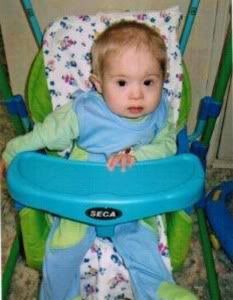
When we look at the hundreds of orphaned or abandoned kids who are listed on Reece's Rainbow, we find it so easy to assume what seems obvious: That most of them have no hope and no future. It is so easy to believe that their lives are over. This seems especially true of the older kids: It is so easy to assume that they are too old and too institutionalized to make it in the outside world.


The story of Millie's life proves otherwise.
Millie's story shouts "Hope!" to the hopeless.

She was institutionalized for 30 years, and demeaned as a moron.
Then she emerged from that institution to live a successful life that touched the lives of so many others, including me.
Millie's story gives hope to all of the Lost Boys and Lost Girls who are locked away behind institutional walls.

Her story is a reminder that God, in His infinite mercy and love, cares for the orphans and the widows.

Millie was both.
Orphaned and widowed.
Rejected and abandoned.

And yet, Millie was loved, forever loved, by the God who created her and drew her to Himself.
I miss Millie. I miss sitting in church with her wrinkled old hand safely in mine. I miss listening to her fuss at her cats. I miss walking in her weed-filled garden. I miss my sweet Millie.
I know where she is, though. And I rejoice that I will see her again.
And I am forever grateful that she lived long enough so that I could have the blessing of knowing her.
I thank God for Millie.




.jpg)
.jpg)
.jpg)


