It's Friday morning, and we're sitting in our hotel trying to sort through what's happened this week.
It all started on Monday morning, when we walked into the government office that handles adoptions here. This is where we would see Mary's file for the first time, and request a referral to meet her.
The first thing we learned was that Mary wasn't where we thought she was. We hoped and believed she was still at her baby house; but alas, she has already been transferred. Her new home is a special needs institute for boys and girls aged 4 - 18. Some are only mildly disabled, others profoundly so. Most of them spent the summer at "camp"-- a nice word for a not-so-nice place where the children go so the institute staff can have a holiday. Mary and some other little ones were to be summoned back from camp a few days early, so we could meet her. The rest of the children would come back for the first day of school, September 1st.
The next thing we learned set our hearts spinning. While sifting through the foreign conversation in the office, we heard the dreaded word "brat"-- brother. Unknown to anyone before now, Mary had a brother-- which meant that we might lose her. If the brother was available for adoption, then we might have two choices: take both, or take neither. They would not split up brother and sister for foreigners, even if the siblings had never met.
The next while was a bit tense, to say the least. Our lawyer hustled us out of the office so that the officer could investigate the brother's situation. Our facilitation team also investigated, calling its contacts in Mary's region. We had minutes to decide what we would do if the brother was available. How could we take both, when we didn't have a bedroom for a boy?
Imagine our relief when we got the news: the brother had already been adopted. They are happy to split siblings for natives, just not for foreigners. We went back into the meeting thinking, "Problem solved"-- only to learn that Mary had another brother!
The good news was that this second brother didn't seem to be "in the system," which meant that he probably wasn't available for adoption. Our facilitators seemed satisfied with this; but it was cold comfort to us. We left our appointment not knowing for sure if we would ever meet Mary.
We spent the next 28 hours in a fog of the unknown. It was a time of praying and wondering. We had no news until Tuesday afternoon, when we went back to pick up the referral.
It was then that we heard, through unofficial office gossip, that the second brother had not been found in the system. We would hear no more until we reached the institute; for only the director there had Mary's full file. The files in the capital hold only bits and pieces, many of them wrong. It is a sad, broken system, and we were feeling its brokenness as we left with Mary's referral.
We headed out to region early Wednesday morning. A two-hour drive brought us to the director's office, where we finally got the straight dope. Mary's brothers were both younger than she, and came from a different father. The younger was adopted, and the older was with his father. So that issue was finally put to rest, 48 hours after we learned of it. It was the biggest relief of the day.
We also learned why Mary was abandoned, we think: because she has epilepsy. The poor child lived with her mother almost four years, until she got sick enough to need a hospital. It seems that her mother dropped her off there when she started having seizures, and never came back. The mother lost her parental rights, and Mary became a ward of the state. She went from the hospital to the baby house, where she spent about two years. Then it was off to the institute this past May.
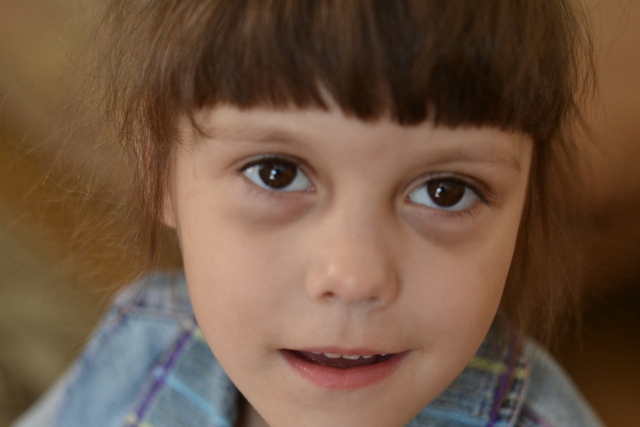
The actual meetings always come as a surprise to us foreigners. We were on our way to a pre-school room when we came across a caretaker in a hall, overshadowing a tiny little girl. It took a second to recognize her as Mary; for she was much more haggard than the girl in her pictures.
She was also terrified, of course. It took most of her strength to climb the stairs to the pre-school room, where we all sat while our facilitator read through her file. She was playing with a puzzle when we saw the first seizure.
It's the sort of thing that's hard to believe until you see it with your own eyes. Mary suffers from a fairly rare type of seizure called "atonic"-- without muscle tone. One second, she's as alert as can be. The next, she flops down like a rag doll-- as if someone cut a wire in her brain. Two to five seconds later, she goes right back to what she was doing before-- as if she has no idea anything happened.
This is a long way from what we were expecting, to say the least. We'd been told that Mary's epilepsy was mild, and caused her few problems. Yet in the first hour we spent with her, she had at least ten drop attacks. We also saw times when her eyes fluttered, but she didn't drop. We think these little episodes are probably mini-seizures. Plus her hands are shaky, although this may be a side effect of her medication.
The biggest danger of drop attacks isn't the seizures themselves, but the falling. Mary smacked her head on the table once in that first meeting, even though the caretaker was holding her. She had another drop attack on the way out, right at the top of the stairs. If the caretaker hadn't been holding her hand, then she surely would have fallen down the whole flight.
What we're wondering now is, how in the world are we going to keep this little girl safe? The seizures come on too fast for her caretakers to react, even if they're being careful. Rob's spent the last few visits following her around with his arms corralled around her. Lest you think that's over-protective, he's already saved her from falling many times. She's safe on a couch, provided she's sitting back. She's only safe at a table if she's strapped to her chair-- up high, so that her head can't fall forward. It's all rather scary, and we are a bit overwhelmed!
The first step is obvious: The child needs a helmet or headband to save her poor head from hematoma and concussion. The next step is to find her a good doctor. An EEG will give us a better idea what we're dealing with. She needs off her medication, which obviously isn't working, and on some better ones. From what we read, though, atonic seizures don't always respond to medication; and even if they do, it takes time and trial to find the right ones. People also recommend the ketogenic diet, which sounds dreadful. "Welcome home, little girl, here's a list of all the things you can't eat: anything sweet, and anything fun."

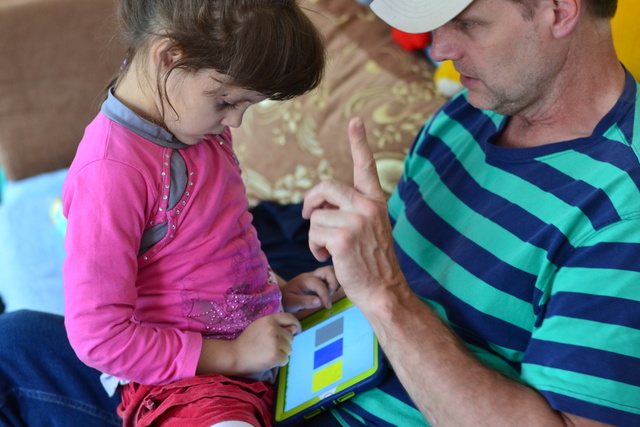
Then there are the behaviors. Mary is an active child who is tired of being restrained. She seems to see us as her ticket to freedom, her chance to break all the rules. We have little authority over her; for we aren't her parents yet, and aren't on our home turf. The caretakers are nice, but we're still paranoid about upsetting them. Beyond that, Mary's way behind developmentally. Her calendar age may be six, but her developmental age is somewhere between two and three.
And yet... what a darling. People used to call epilepsy the "sacred disease," probably because they associated it with visions. We know it's more scourge than sacred; but even so, there's something special about it. It's a whole new feeling, having a child flop down in one's arms like that. There's nothing we wouldn't do to help this helpless little girl.
Needless to say, it's been an exhausting week. We are emotionally drained and physically worn down. We plan to stay and visit for a few days, and then head home Sunday or Monday to wait for court.
Alas, the wait may be far longer than we like; for adoptions are getting harder over here. Certain government figures seem to care more about national pride than they do about children's lives. Please pray that the Lord will tear down all the obstacles they throw up.